Beyond the Basics: Unpacking Kotler’s Five Levels of a Product
When we think about a product, we usually think about the thing itself. If you buy a car, you think about the engine, the wheels, and the steering wheel. If you book a flight, you think about the ticket and the destination.
But if that’s all there was to it, why do we choose one brand over another? Why are we loyal to an airline that offers a warm cookie, or a software company that answers the phone on the first ring?
The answer lies in a framework that has stood the test of time. Back in 1967, marketing legend Philip Kotler published Marketing Management and introduced a concept that changed how businesses view value creation: The Five Levels of a Product.
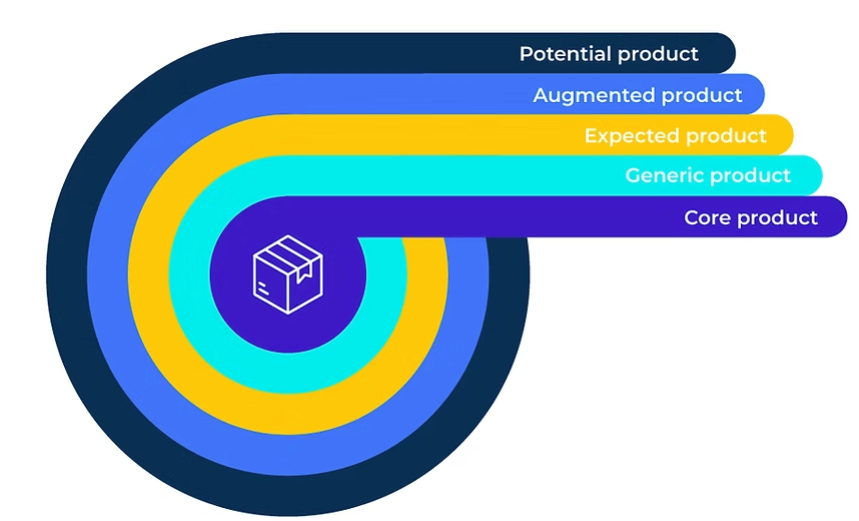
Kotler’s insight was simple yet profound: Competition takes place more at the augmented level than at the core level. In other words, it’s rarely the basic product that wins the sale. It’s everything that wraps around it.
Let’s break down the five levels and explore how they can transform your approach to innovation, pricing, and customer satisfaction.
The Five Levels Explained
Kotler’s model suggests that a product is not a monolithic object. Instead, it is a layered bundle of value. Here is how it stacks up:
1. The Core Product: The "Why"
At the very center lies the core product. This isn’t the physical item; it’s the benefit the customer is really buying.
Example: An airline passenger isn’t buying a piece of paper (a ticket) or a seat. They are buying transportation from Point A to Point B. If the flight doesn’t get them there, nothing else matters.
2. The Generic Product: The "What"
This level translates the core benefit into a tangible offering. It represents the basic features and qualities necessary for the product to function.
Example: For the airline, the generic product is the actual aircraft, the pilot, and the adherence to a schedule. It’s the bare-bones version of the product that fulfills the core promise—safely and on time.
3. The Expected Product: The "Baseline"
This is where customer expectations come into play. These are the attributes and conditions the buyer assumes they will get when they purchase.
Example: When you book a flight, you expect a degree of comfort. You expect a clean cabin and a friendly crew. If these expectations aren’t met, the customer is dissatisfied—even if the plane landed on time.
4. The Augmented Product: The "Wow"
This is the battleground for modern business. The augmented product includes everything that adds value beyond the customer’s baseline expectations. It is often intangible and serves as the primary differentiator between you and your competitors.
Example: This is the brand reputation, the seamless app check-in, the loyalty program points, and the free drink at 30,000 feet. It is the "experience" wrapped around the seat.
5. The Potential Product: The "What If"
The final level looks to the future. It encompasses all the augmentations and transformations the product might undergo in the future. It is a vision of evolution.
Example: For an airline, this could be supersonic travel, fully automated check-in via biometrics, or perhaps even stripped-down "ultra-budget" versions of existing routes to capture new markets.
Why This Matters for Every Business
Kotler’s framework is crucial because it highlights a universal truth: Customers don’t buy products; they buy satisfaction.
A customer will choose a product based on the total value perceived across all five levels. If that value is met, they are satisfied. If it is exceeded, they become loyal.
But here is the trap that many businesses fall into: they focus all their energy on the core or generic product while ignoring the augmented layers.
Consider the concept of commodities. You might think a commodity—like a bag of wheat or a steel pipe—is purely a core product with no room for differentiation. But that’s not true. Even commodities gain value from the company that sells them, the speed of delivery, the reliability of supply, and the ability to resolve issues quickly.
At the other end of the spectrum, look at luxury goods like perfume. You aren’t paying for the liquid in the bottle. You are paying for the packaging, the brand story, the emotions the scent evokes, and the status it confers. That is the augmented product in action.
Pricing and Equilibrium
This framework also clarifies pricing strategy. All products have a price, but that price shouldn’t just be "cost plus a margin." Price should reflect the perceived value across all five levels.
If you try to charge a premium price while offering only a generic product, you will lose the market. Conversely, if you offer a highly augmented product but price it like a commodity, you leave money on the table. For a company to be successful, the product (in its broadest sense) and the price must be in equilibrium.
A Blueprint for Innovation
Perhaps the most practical takeaway from Kotler’s model is that it shows us where to innovate.
When we think about new product development, we often obsess over the core product. How can we make the engine faster? How can we make the ticket cheaper?
But Kotler suggests that the most impactful innovations usually occur at the augmented level. Improvements to core needs are often incremental. True differentiation comes from enhancing the features, services, and experiences that surround the product.
So, how do you figure out what to augment? It starts with observation. Ethnographic research—watching how customers actually use your product in their real environment—is invaluable. You might discover that the "problem" you need to solve isn’t a missing feature in your software, but a confusing onboarding process. You might find that the "competition" isn’t another product, but the hassle of using yours.
Final Thoughts
Whether you are selling a $2 billion aircraft or a $2 cup of coffee, Kotler’s Five Levels of a Product offers a vital lens.
It reminds us that a company’s "offer" is always supported by something more than the tangible item. It is supported by trust, convenience, emotion, and service. By understanding these five layers, you stop competing on price and start competing on value.
So, take a look at your own product. Are you just selling a ticket—or are you selling a journey?
Comments